
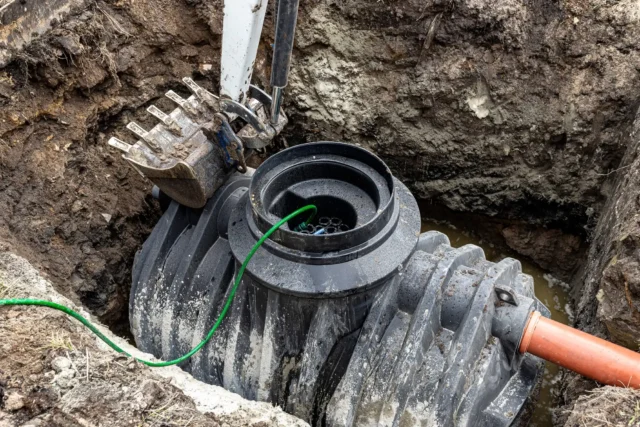
A leach field may be repairable when the problem involves damaged distribution pipes, a malfunctioning distribution box, or another correctable component. Replacement may be necessary when the soil can no longer absorb and treat wastewater adequately or when the existing system cannot meet applicable requirements.
The decision between leach field repair vs replacement depends on identifying why wastewater is no longer moving through the system properly. A professional septic inspection should evaluate the piping, distribution components, soil conditions, and septic tank before recommending targeted repairs, rehabilitation, or a permitted replacement.
Can a Leach Field Be Repaired, or Does It Need Replacement?
A leach field, also called a drainfield, distributes wastewater from the septic tank into the surrounding soil for additional treatment and dispersal.
When the system stops functioning properly, homeowners may notice slow drains, sewage odors, saturated ground, or wastewater backing up into the house.
However, these symptoms do not automatically mean the entire leach field has failed.
Sometimes, the underlying problem involves a specific component that can be repaired or replaced without rebuilding the whole field.
Other situations involve reduced soil absorption capacity, prolonged saturation, or damage affecting multiple absorption areas.
The difference matters because repairing a damaged pipe does not necessarily restore soil that can no longer accept wastewater.
Three Possible Outcomes
A professional evaluation generally helps determine whether the system needs:
- Targeted repair: Correcting a damaged pipe, distribution box, connection, or other identifiable defect.
- Rehabilitation: An approved intervention intended to address a specific performance problem while retaining suitable existing components.
- Replacement: Constructing a new or substantially reconstructed drainfield when the current absorption system cannot function adequately.
Rehabilitation is not appropriate for every failed field, and no treatment should be assumed to restore lost soil capacity.
At HoneyBee Septic Tank Service, we provide drain and leach field repair for homeowners in Mount Pleasant and Charlotte, NC.
Our approach begins with identifying the underlying problem before discussing the available repair options.
Which Problems May Allow a Targeted Repair?
Some drainfield problems affect how wastewater reaches or moves through the absorption area rather than the soil’s underlying ability to treat it.
When the problem is isolated and the remaining field remains functional, targeted repairs may be possible.
Damaged or Blocked Distribution Pipes
Drainfield distribution pipes carry wastewater to the soil absorption area.
Over time, piping may become damaged by soil movement, root intrusion, or external pressure.
Blockages can also prevent wastewater from reaching certain sections.
A contractor may identify a damaged connection or restricted pipe that can be repaired or replaced.
However, the condition of the surrounding soil must also be evaluated.
Restoring flow through a pipe will not resolve a drainfield whose absorption capacity has already deteriorated.
Malfunctioning Distribution Boxes
A distribution box directs wastewater from the septic tank toward multiple drainfield lines.
Its purpose is to distribute the flow according to the system’s design.
If the box shifts, cracks, or becomes obstructed, wastewater may be distributed unevenly.
One section of the field may receive excessive wastewater while another receives very little.
A damaged distribution box may sometimes be repaired or replaced without replacing the entire drainfield.
However, the contractor must determine whether the overloaded section has also experienced soil-related failure.
Correctable Upstream Problems
A problem between the septic tank and drainfield can sometimes resemble drainfield failure.
For example, a blocked outlet, malfunctioning pump, or damaged connecting pipe may prevent wastewater from reaching the absorption area correctly.
Repairing the upstream component may restore normal distribution if the field itself remains functional.
This is why an inspection should examine connected components rather than focusing exclusively on the wettest area of the yard.
Localized Root or Pipe Damage
Tree roots can enter damaged connections and interfere with wastewater distribution.
A localized repair may be appropriate when the affected section can be corrected and the remaining system still meets its required performance.
However, root removal alone may not resolve extensive pipe deterioration or damage to the surrounding soil.
The contractor must assess the complete condition before recommending a limited repair.
When Does Soil or Site Failure Change the Decision?
The situation becomes more complicated when the problem involves the soil rather than an individual component.
A septic drainfield relies on the surrounding soil to accept and treat wastewater at an appropriate rate.
When that capacity is substantially reduced, replacing pipes alone may not resolve the problem.
Loss of Soil Absorption Capacity
During normal septic operation, a biological layer develops where wastewater enters the soil.
This layer, commonly called biomat, contributes to wastewater treatment but also influences the rate at which water moves into the surrounding soil.
When wastewater loading becomes excessive or soil conditions deteriorate, infiltration may become insufficient.
Wastewater can then accumulate in the trenches, surface in the yard, or contribute to household backups.
A contractor must distinguish between temporary hydraulic overloading and a persistent loss of absorption capacity.
An existing field with widespread soil failure may require replacement or another approved corrective design.
High Groundwater and Poor Drainage
Drainfields also depend on suitable separation from groundwater and other site limitations.
When groundwater rises into the treatment area, the soil may no longer provide adequate conditions for wastewater treatment.
Heavy rainfall can temporarily worsen existing drainage problems.
However, repeated saturation may indicate a more significant site limitation.
For example, a Charlotte property with a low-lying drainfield may experience recurring problems during wet periods.
The contractor should determine whether the issue involves temporary saturation, surrounding drainage, or unsuitable soil conditions.
Compaction and Physical Damage
Heavy vehicles, construction equipment, and other excessive loads can damage drainfield piping and compact surrounding soil.
Compaction reduces the soil’s ability to accept wastewater.
In some cases, repairing damaged piping may be possible. In others, the affected absorption area may no longer function adequately.
Soil conditions must be evaluated before assuming that mechanical treatment or cleaning will restore performance.
Can Leach Drain Rehabilitation Restore a Failed Field?
Some contractors offer leach drain rehabilitation methods intended to address specific restrictions or distribution problems.
However, these methods are not universally effective.
Products marketed as drainfield rejuvenators should be approached cautiously.
The Environmental Protection Agency advises against relying on septic additives to correct system problems because certain chemicals can damage components or interfere with treatment.
Any proposed rehabilitation method should have a clear technical purpose, appropriate supporting evidence, and any required approvals.
No contractor should guarantee that rehabilitation will restore every failed drainfield.
What Should the Diagnostic Evaluation Include?
A reliable diagnosis examines the complete wastewater pathway, from the septic tank outlet to the surrounding absorption soil.
The goal is to identify whether the system has a repairable component failure, a hydraulic problem, or a more extensive site limitation.
Review the System’s History
A contractor may begin by reviewing available installation plans, permits, maintenance records, and previous repairs.
These records can help establish the field’s approximate location, configuration, and intended capacity.
Homeowners should also describe when problems started and whether the symptoms change during heavy rain or periods of increased household water use.
Recurring failures after previous repairs may indicate an unresolved underlying problem.
Inspect the Septic Tank and Distribution Components
The inspection may include checking the tank’s operating condition, outlet, effluent filter, and distribution box.
Professionals may also evaluate:
- Wastewater levels and evidence of backup
- Flow through accessible distribution components
- Damaged or obstructed piping
- Structural deterioration
- Uneven wastewater distribution
- Evidence of groundwater entering the system
Camera inspections may help locate restrictions or damaged piping, depending on the system.
However, a camera cannot determine the complete treatment capacity of the surrounding soil.
Evaluate the Drainfield and Soil
The contractor may inspect the yard for wet areas, wastewater surfacing, unusual vegetation growth, and other signs of malfunction.
Additional evaluation may involve examining distribution trenches, soil conditions, groundwater limitations, or the property’s available replacement area.
These investigations should be performed by appropriately qualified professionals and coordinated with the relevant permitting authority when required.
A professional should also determine whether the existing drainfield has enough functional capacity to remain in service.
Explain the Diagnosis Before Recommending Work
Homeowners should receive a clear explanation of what failed and how the proposed repair addresses that failure.
For example, finding a cracked distribution box supports investigating a component repair.
Finding wastewater accumulating throughout the absorption area may require a broader evaluation.
At HoneyBee Septic Tank Service, we can assess drainfield problems and discuss the next steps based on the system’s condition.
How Do Repair and Replacement Scopes Differ?
Repair and replacement can involve substantially different work, even when both are intended to resolve similar symptoms.
The appropriate scope depends on the diagnosis, existing system design, and applicable requirements.
Targeted Drainfield Repair
A targeted repair generally concentrates on a specific damaged component or section.
Possible work includes replacing a damaged distribution box, repairing connecting pipes, or correcting an identified flow restriction.
The existing drainfield may remain in use if evaluation establishes that it can continue functioning adequately.
However, the contractor must confirm that repairing the component will address the actual cause of malfunction.
Drainfield Replacement
Drainfield replacement involves establishing a suitable wastewater absorption area when the existing field cannot continue functioning as required.
Depending on the property, work may include site evaluation, soil assessment, system design, excavation, distribution components, and inspections.
A replacement field cannot simply be installed anywhere open space is available.
Soil characteristics, available area, setbacks, groundwater conditions, and the approved design all influence placement.
HoneyBee also provides drain and leach field installation services for properties requiring an appropriate replacement system.
Comparing the Work
| Consideration | Targeted repair | Drainfield replacement |
|---|---|---|
| Main purpose | Correct a specific defect | Establish a functioning absorption system |
| Existing components | Suitable components may remain | Existing field may be retired or reconstructed |
| Soil evaluation | Depends on the identified problem | Usually central to design |
| Excavation | Often localized | May involve a larger area |
| Approvals | Depend on work classification | Generally involves design and authorization |
| Final cost | Depends on repair scope | Depends on site and approved design |
North Carolina distinguishes routine maintenance from work classified as wastewater system repair or construction.
Required permits and authorizations should be confirmed before starting work. An approved permitting pathway may vary according to the system and project.
What Questions Should You Ask About a Repair Quote?
A drainfield quote should explain the cause of the problem and identify exactly what work is being proposed.
Comparing total prices without understanding the scope can lead homeowners to choose a repair that does not address the underlying failure.
Confirm What the Quote Includes
Ask the contractor:
- What evidence supports the diagnosis?
- Is the problem in a pipe, distribution component, or absorption soil?
- Which existing components will remain in service?
- What repairs or rehabilitation procedures are proposed?
- Is further soil evaluation necessary?
- Which permits and inspections apply?
- What excavation and site restoration are included?
- What happens if additional damage is discovered?
A written quote should distinguish confirmed work from possible additional repairs.
Ask How Success Will Be Evaluated
A repaired component may be tested for proper flow or operation, but that does not automatically establish long-term field performance.
Ask which inspections or tests will be completed and what they can demonstrate.
If rehabilitation is proposed, request an explanation of the method, its limitations, and whether it is appropriate for the identified problem.
Avoid assuming that a temporary improvement means the absorption soil has fully recovered.
Compare Long-Term Suitability
A limited repair may cost less initially than replacement.
However, a lower price is not automatically better if the field has widespread soil failure.
Likewise, replacement may be unnecessary when a localized defect is responsible for the symptoms.
The most appropriate proposal should address the diagnosed condition and provide a reasonable basis for the recommended scope.
FAQs
Can Pumping Fix a Failed Leach Field?
Septic pumping removes accumulated solids and liquids from the septic tank, but it does not rebuild damaged distribution pipes or restore soil absorption capacity. It may provide temporary relief in certain circumstances while the problem is evaluated. A contractor must determine whether the field itself requires repair or replacement.
What Makes a Drainfield Repairable?
A drainfield may be repairable when the problem is limited to damaged piping, a distribution box, or another correctable component. The remaining field must still be capable of treating and dispersing wastewater appropriately. An inspection is needed to establish whether a targeted repair is suitable.
Can a Distribution Box Cause Drainfield Failure?
Yes. A damaged, obstructed, or improperly positioned distribution box can direct excessive wastewater toward certain drainfield lines. This uneven loading may contribute to saturation or system malfunction. Correcting the box may help if the affected absorption areas remain functional.
When Is Leach Field Replacement Necessary?
Replacement may be necessary when the soil can no longer accept wastewater adequately, extensive damage affects the absorption system, or the existing configuration cannot meet applicable treatment requirements. Site conditions and permitting requirements determine which replacement options are feasible.
How Do Repair and Replacement Quotes Differ?
Repair quotes generally focus on identified components and localized work. Replacement quotes may involve soil evaluation, design, excavation, new distribution materials, approvals, and inspections. Homeowners should compare itemized scopes rather than relying on the total price alone.
Can a Drainfield Be Rehabilitated Without Digging?
Certain maintenance or rehabilitation procedures may involve limited excavation, but their suitability depends on the actual problem. No method can be assumed to restore a field with inadequate soil treatment capacity. The contractor should explain the proposed process and its limitations.
Find Out Whether Your Leach Field Can Be Repaired
A malfunctioning drainfield does not always require complete replacement. The appropriate solution depends on identifying whether the problem involves distribution components, damaged piping, or the surrounding soil.
At HoneyBee Septic Tank Service, we provide drainfield inspections, repairs, and replacement services for homeowners in Mount Pleasant and Charlotte, NC, and surrounding communities within our service area.
We can evaluate your septic system, explain the findings, and discuss appropriate repair or replacement options.
Call HoneyBee Septic Tank Service at (704) 247-1145 to schedule a drainfield assessment and determine the next step for your property.